
There are rules about how much alcohol you can have in your system when driving, and these limits aren’t the same everywhere. Scotland has lower limits than England and Wales. The amount they measure is in your breath, blood or urine. It's a serious issue; in Great Britain in 2024, a driver or rider over the limit was involved in about 14% of all road deaths.
The limits at a glance
| Sample | England and Wales | Scotland | Northern Ireland |
|---|---|---|---|
| Breath (microgrammes per 100 millilitres) | 35 | 22 | 35 |
| Blood (milligrammes per 100 millilitres) | 80 | 50 | 80 |
| Urine (milligrammes per 100 millilitres) | 107 | 67 | 107 |
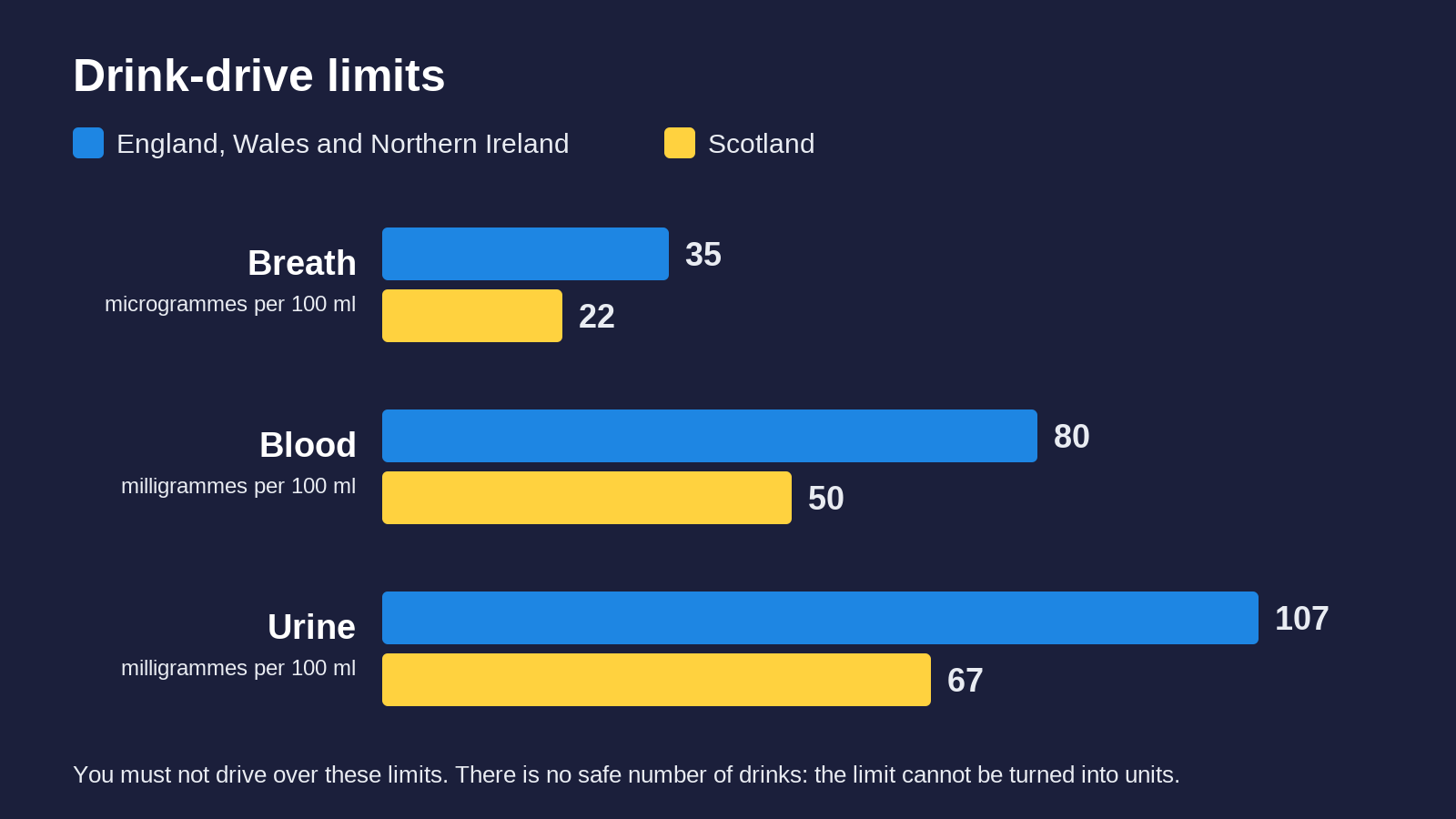
England and Wales: 35 and 80
The law says you must not drive with a breath alcohol level higher than 35 microgrammes/100 millilitres or a blood alcohol level above 80 milligrammes/100 millilitres. The limit for urine is 107 milligrammes per 100 millilitres. Northern Ireland uses the same three limits.
Scotland: 22 and 50
In Scotland, you must not drive with a breath alcohol level higher than 22 microgrammes/100 millilitres or a blood alcohol level above 50 milligrammes/100 millilitres. For urine, the limit is 67 milligrammes per 100 millilitres. These lower limits came into effect in December 2014 and were changed from earlier higher levels.
Why you cannot count drinks
It’s impossible to work out exactly how many drinks that equals for you, as it changes depending on lots of factors: your weight, age, sex, how much you've eaten, what type of alcohol you've had, and even if you’re stressed. It's not safe to think you can calculate a safe amount; just one drink could put you over the limit. If you plan to drive, the best choice is not to drink at all, as any amount of alcohol affects your driving.
The proposed cut: where it stands
The government is considering lowering the drink drive limits in England and Wales, including an even lower limit for new drivers. They asked for people's opinions on this between January and May 2026. Right now, they’re looking at all that feedback, but nothing has changed yet. So, things are still as they were: 35, 80 and 107 for England and Wales.
What alcohol does to your driving
Alcohol makes you feel confident, but it's a trick. It slows down how fast you react and affects how well you judge distances and risks. In Great Britain in 2024, young drivers under 20 were involved in an estimated 85 drink-drive collisions per billion miles driven, against 15 across all ages.
The morning after
You might still be unfit to drive the evening after drinking at lunchtime or in the morning if you had drinks the night before. It can take up to 24 hours or longer for it all to clear out of your body.
Plan before you drink
If you do decide to have a drink, make sure you’ve arranged another way to get around. New drivers shouldn't drive at all if they’ve had any alcohol or drugs.
A worked example: crossing into Scotland
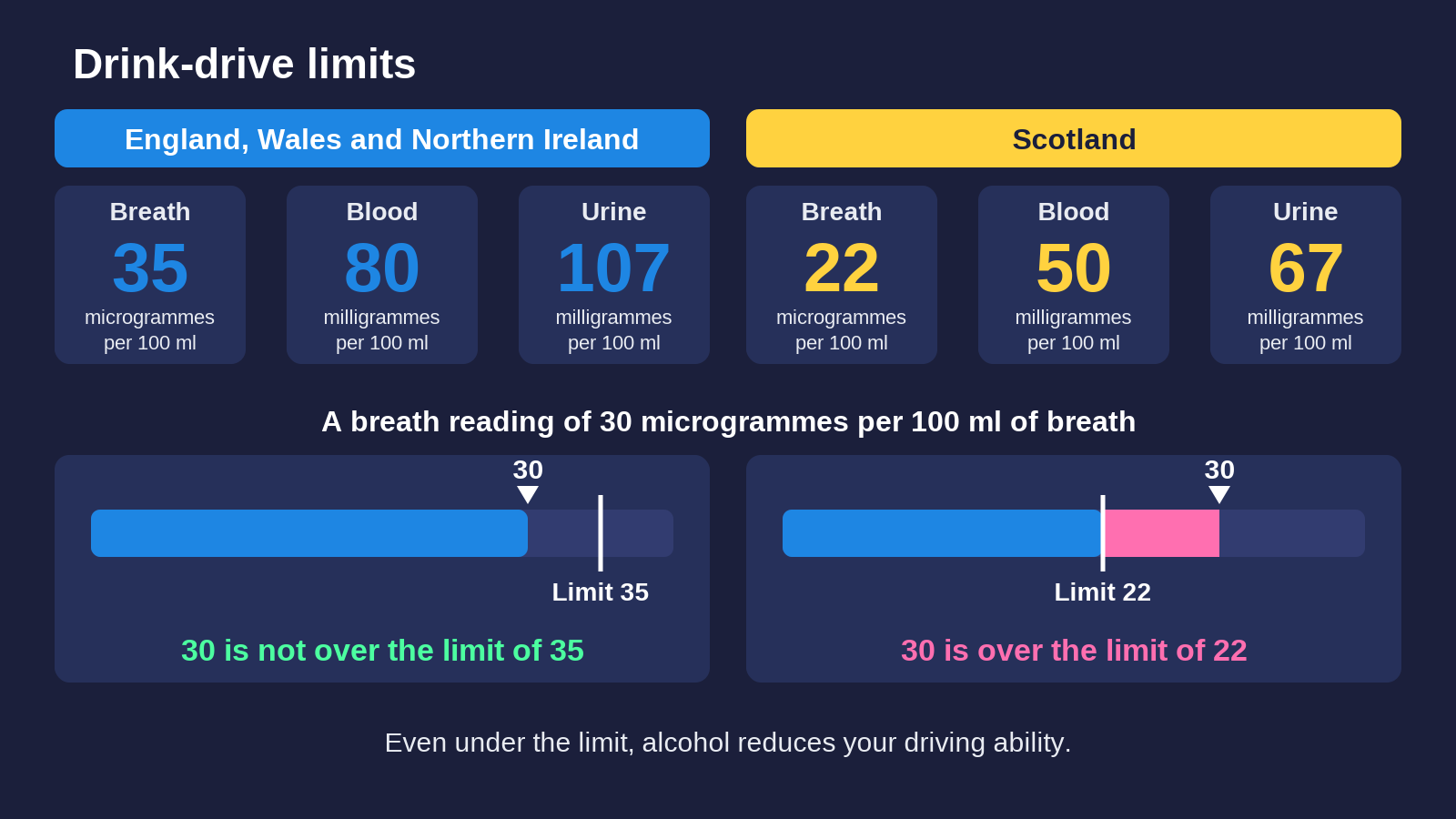
A breath reading of 30 microgrammes per 100 millilitres of breath wouldn't be over the English and Welsh limit of 35, but it would be above Scotland’s limit of 22. Remember that driving in Scotland means following Scottish rules. Even below the legal limit, alcohol impacts your ability to drive properly. There's also an offence for driving while unfit through drink.
If the police stop you
Police can stop you at any time and ask for a breath test if they think you might have been drinking or if you’ve broken a traffic law or been involved in a road traffic accident. Refusing to take a breath test without good reason, or failing it, can lead to arrest and charges. If you fail the roadside breath test, they'll take you to the station for another test. If that’s positive too, you’ll be charged.
Common mistakes
Don't try to work out how many drinks are safe. Don’t think a good night’s sleep will clear you; it may not. It’s not okay to assume being under the limit means you are driving safely, and don't forget that being "in charge" of a vehicle while over the limit or unfit through drink still counts as an offence.
Quick quiz
- What is the breath alcohol limit in Scotland?
- What is the blood alcohol limit in England and Wales?
- Can you be unfit to drive the morning after drinking?
- What is the minimum driving ban for drink-driving in England and Wales?
Answers, in order: 22 microgrammes per 100 millilitres of breath; 80 milligrammes per 100 millilitres of blood; yes, you may be unfit in the morning after drinking the previous evening; and 1 year, or 3 years if you are convicted twice in 10 years.
Questions people ask
What happens if you are caught over the limit?
In England and Wales, for driving or attempting to drive while over the limit, you might be sent to prison for up to six months and get a fine that has no upper limit. Refusing without a reasonable excuse to give a breath, blood or urine sample for analysis carries the same penalties. The court normally has to order disqualification, which will be a minimum of twelve months. In Scotland, mygov.scot says you'll get a minimum 12-month ban and could go to prison for up to six months or get a fine of up to £5000, or both.
Is there a lower limit for learner and new drivers?
Currently, the drink-drive limits are the same for everyone in England and Wales. However, the government consulted on whether to introduce a lower limit specifically for novice drivers. They asked people what an appropriate limit would be, though no figure was put forward at that time.
Will the drink-drive limit in England and Wales be lowered?
The current blood-alcohol limit in England and Wales is considered to be the highest in Europe. As part of a road safety strategy, the government consulted on whether the limit should be lowered or stay the same. Estimates suggested lowering it might reduce fatalities by between twenty-five and one hundred annually. The consultation closed in May 2026, but as of November 2026, no outcome or new figures have been published yet.
Is the drink-drive limit the same in Northern Ireland?
At present, Northern Ireland shares the same limits as England and Wales, 35/80/107. However, plans are in place to reduce these limits in the near future to lower levels for everyone, including new and professional drivers. The consultation document gives no date for any change.
Did Scotland's lower limit work?
The evidence suggests that while Scotland's lower limit didn’t lead to a significant reduction in casualties, it did seem to strengthen attitudes against drinking and driving. It also appears any lowering of the legal limit needs to be backed up by stronger enforcement.
Sources
The drink drive limit, Drink-driving penalties, Stopped by the police: breath tests, The Highway Code, rules 89 to 102, Annex 5 and Annex 8, the Road Safety Strategy, the consultation Proposed changes to penalties for motoring offences and Reported road casualties in Great Britain: drink-drive collisions 2024 (GOV.UK), Road Traffic Act 1988, section 11 and SSI 2014/328 (legislation.gov.uk), Drink-drive limit in Scotland (mygov.scot) and Drink-driving (nidirect). Contains public sector information licensed under the Open Government Licence v3.0.