

The 12 o'clock trick
A helpful way to picture roundabouts is like a clock face. You're coming in at six o'clock and straight ahead would be twelve. It can help you work out which lane to be in for your exit. It isn't in the Highway Code, so it's just a handy mental picture.
If you're taking the first exit to your left, or exiting right past midday, you should indicate correctly. It depends on which way you're heading, unless signs or lane markings say otherwise; for the first exit to the left, indicate left, approach in the left-hand lane and keep signalling left until you leave. If you're taking a right-hand exit, or going all the way round, signal right to begin with, approach in the right-hand lane, and then signal left after passing the exit before your intended one. However, if you're going straight ahead at twelve o'clock, or taking an exit somewhere in between, you normally don't need to signal when approaching; just stick to the correct lane, then signal left once you've passed the exit before yours.
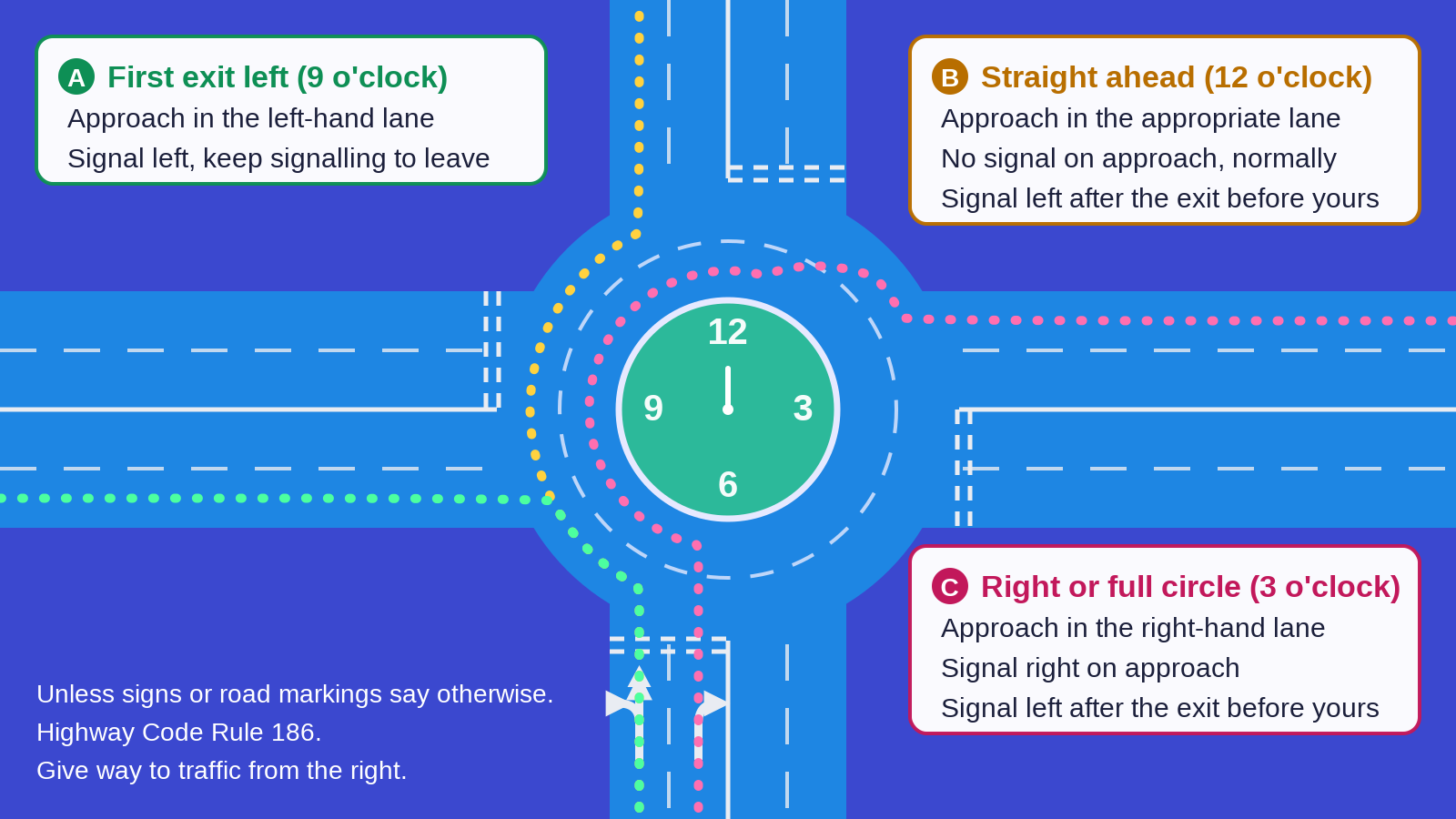
Approaching a roundabout
Be really aware of your surroundings when you get near a roundabout. Pay attention to the signs, traffic lights and lane markings that tell you which lane you need. Remember to use the Mirrors, Signal, Manoeuvre routine. Look around, signal your intentions where needed, and get yourself into the correct position safely. Decide on your exit early and put yourself in the correct lane to be ready. Adjust your speed as needed too.
Who gives way at a roundabout
Remember to give way to any traffic coming from your right unless there are signs, road markings or traffic lights telling you otherwise. Even if markings say you have priority, still glance right before joining. Be aware that other drivers may not signal their intentions correctly, or at all, when on the roundabout. Before you go, check that the traffic in front has moved off too.
7 steps, 0:28 Roundabouts: who goes first
Step 1 of 7 Roundabouts: who goes first
Step 2 of 7 Give priority to traffic coming from your right.
Step 3 of 7 Wait at the broken white line.
Step 4 of 7 They may not signal correctly, or at all.
Step 5 of 7 Look right again, then go when it is clear.
Step 6 of 7 Traffic moves one way, round the central island.
Step 7 of 7 At a roundabout, give priority to traffic from your right.
Not loaded Check the connection, then press Try again.
Signals and position
Here's the Highway Code on roundabout signals and lanes, kept close to its own words.
When using the first exit to your left, unless signs or markings show otherwise:
- indicate left and approach using the left-hand lane
- stay to the left on the roundabout and keep signalling left to leave.
When using an exit to your right or going full circle, unless the signs or markings show otherwise:
- indicate right and approach using the right-hand lane
- stay to the right around the roundabout until you have to change lanes to leave the roundabout
- indicate left after you've passed the exit before the one you need.
When using any intermediate exit, unless the signs or markings show otherwise:
- select the correct lane on approach to the roundabout
- you shouldn't normally need to signal on approach
- remain in this lane until you have to alter course to leave the roundabout
- indicate left after you've passed the exit before the one you need.
Where there are more than three lanes at an entrance to a roundabout, use the most suitable lane on approach and through the roundabout.
You should give priority to any cyclists on the roundabout. They'll be travelling more slowly than motor traffic. Give them plenty of space and don't try to overtake them in their lane. Allow them to cross your path as they travel round the roundabout.
Cyclists, horse riders or horse drawn vehicles may remain in the left-hand lane when they plan to continue across or round the roundabout and should indicate right to show you they're not leaving the roundabout. Drivers should take great care when entering the roundabout to ensure that they don't cut across any cyclists, horse riders or horse drawn vehicles within the left-hand lane, who are continuing round the roundabout.
Watch the three exits
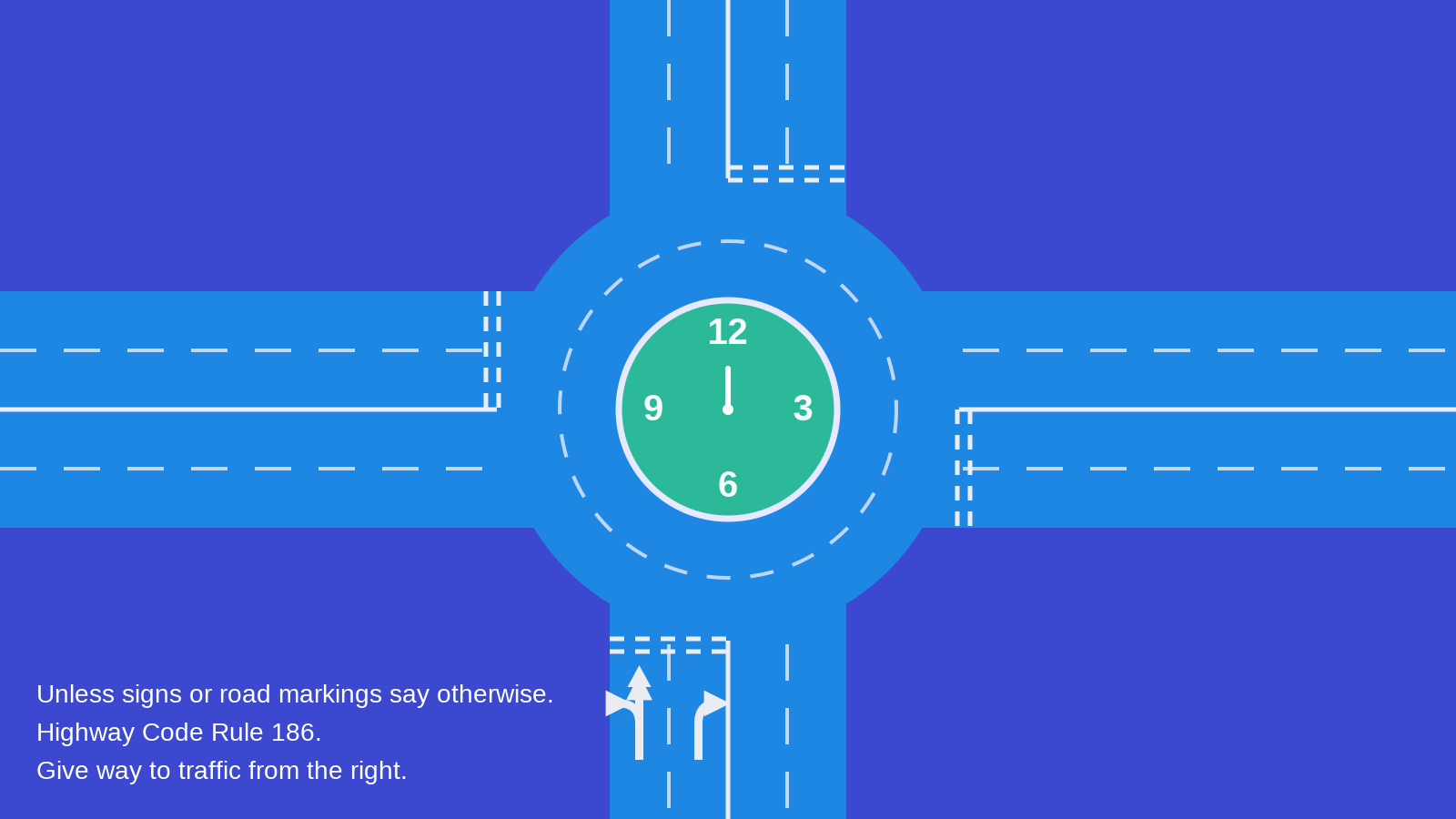
Car A signals left the whole way. Car B signals only once it has passed the exit before its own. Car C signals right, then left after the exit before its own.
In short, unless signs or markings say otherwise:
| Your exit | Lane on approach | Signal on approach | Then |
|---|---|---|---|
| First exit left | Left-hand lane | Left | Keep signalling left to leave |
| Any exit in between | The appropriate lane | Normally none | Signal left after the exit before yours |
| Exit to the right, or full circle | Right-hand lane | Right | Keep right, then signal left after the exit before yours |
Mini-roundabouts
Mini-roundabouts are pretty much the same as regular ones. Give way to traffic on your right unless there are signs, road markings or traffic lights telling you differently. All vehicles must go around the central markings except for larger vehicles that physically can't manage it. Avoid trying to do a U-turn on these, and if there's a double mini-roundabout, treat each one separately and give way to traffic arriving from the right.
Always be mindful of cyclists, pedestrians, motorcyclists, and long vehicles. They all need space too.
Common mistakes at roundabouts
Remember to go through Mirrors, Signal, Manoeuvre at each point of the roundabout. Time your signals so nobody's confused, and pick your exit early. Check that the vehicles ahead have properly moved on before you move again. Drivers may not signal properly, or at all. Watch out for cyclists, horse riders, and horse-drawn vehicles; they can stay in the left-hand lane when carrying on round and should signal right, so pay extra attention not to cut across them. Remember to look for people walking across the roads near a roundabout, as well as any cars that might be badly positioned or spreading across the lanes. Give room to motorcyclists, and to traffic crossing in front of you, especially anyone leaving by the next exit.
Quick quiz
- You're taking the first exit to the left. Which lane, and which signal?
- Your exit is at 3 o'clock. What do you signal on approach, and when do you change it?
- You're going straight ahead at 12 o'clock. Do you normally signal on approach?
- A cyclist in the left-hand lane is signalling right. What does that tell you?
Answers, in order, unless signs or markings say otherwise: the left-hand lane and a left signal; right on approach, then left once you've passed the exit before yours; no, but signal left once you've passed the exit before yours; they're carrying on round, so don't cut across them.
Questions people ask
Do you signal when going straight on at a roundabout?
Unless signs or markings say otherwise, when you're approaching a roundabout and plan to go straight ahead or take any exit between the first one and those on your right, it’s important to pick the right lane beforehand. You shouldn't usually need to signal as you approach; just stick with that lane until you need to change course to leave. Once you’ve gone past the exit before the one you want, then signal left to show your intentions.
Who has priority at a roundabout?
At a normal roundabout, give way to traffic from your right, except where signs, road markings, or traffic lights are telling you otherwise. If road markings let you go without having to give way, that's alright, but still look to your right before joining the roundabout.
Can you do a U-turn at a mini-roundabout?
Vehicles MUST go around the central markings of a mini-roundabout, except for larger vehicles that physically can’t. There's less space and less time to signal there, so avoid doing a U-turn, and watch out for others trying to do one too.
Can you change lanes on a roundabout?
Unless signs or markings say otherwise, you shouldn't generally need to change lanes until it's time to move over for your exit, so keep your place until that point. You should watch out for other drivers who may not be signalling correctly or might even be in the wrong lane. If someone's straddling lanes, make sure you give them space.
What about lorries and long vehicles?
Sometimes larger vehicles like lorries, including those towing trailers, need to take a different path on the roundabout because they are so long; they may have to straddle lanes. Be sure to give them loads of space and keep an eye on their signals.
What about double mini-roundabouts?
If there are two mini-roundabouts close together, just think of them separately and let vehicles approaching from your right have priority at each one. If you're dealing with a more complicated junction involving several mini-roundabouts in a row, handle each one individually and follow standard roundabout rules for all of them.
Where can I practise roundabout questions?
You can practise theory test questions free on driving.uk.com. For the wider rules, see my guide to the Highway Code and UK road signs and their meanings.
Sources
The Highway Code, rules 184 to 190 (GOV.UK). Contains public sector information licensed under the Open Government Licence v3.0.
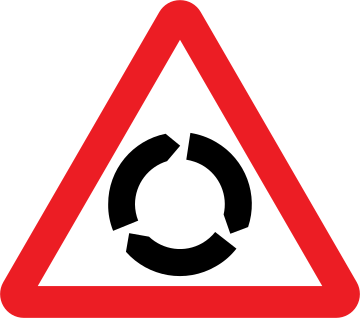
Roundabout sign picture: a drawing of the official UK traffic sign from Wikimedia Commons, in the public domain.