

Those little reflective studs you see? They’re there to help guide you, particularly when it's dark, wet or visibility is poor, and your headlights reflect off them so you can see where you are. Knowing what each colour means can really make a difference.
All five are in Rule 132 of the Highway Code. The diagram below shows where each one sits on a three-lane motorway.
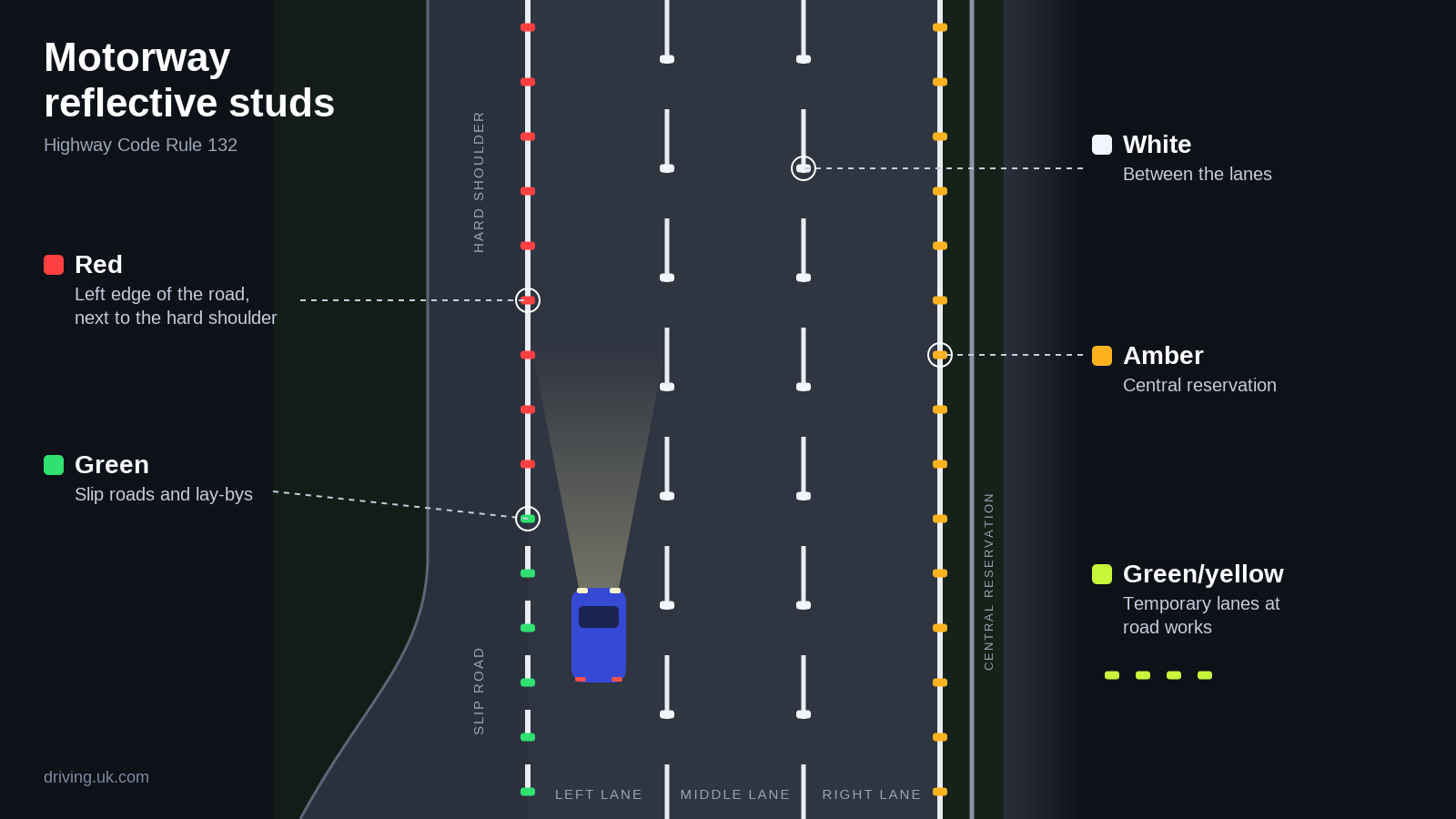
What each colour means
| Colour | Where you see it | What it marks |
|---|---|---|
| Red | The left edge, by the hard shoulder if there is one | The edge of the carriageway |
| White | Between the lanes | The lanes, or the middle of a single carriageway road |
| Amber | The right edge, by the central reservation | The central reservation |
| Green | Gaps at slip roads and lay-bys | Where a slip road or lay-by meets the main carriageway |
| Green/yellow | Temporary lane lines | Lanes moved for a while, for example at road works |
Red studs: the left edge
Red studs mark the left-hand edge of the road on a motorway. If they’re on your left, that's where they should be. If you have red studs to your right, though, you're beyond that edge, potentially on the hard shoulder or the verge. You absolutely MUST NOT use the hard shoulder unless there’s an emergency, or if the police, a traffic officer or a sign tells you to.
White studs: between the lanes
White studs are found on the broken white lines between lanes on motorways, or in the middle of single carriageway roads. You may have them on one side of you, or on both. This shows where the lane markings are.
Amber studs: the central reservation
The central reservation is that strip dividing your side of the motorway from the other. In the UK, this sits to your right. If you’re in the right-hand lane, amber studs will be next to you. Dual carriageways use them in a similar way.
Green studs: slip roads and lay-bys
Green studs mark the edge of the main carriageway at slip roads and lay-bys, both where traffic enters and exits. When you’re joining the motorway, remember Rule 259: drivers joining should give priority to those already on it. I glance at the slip road when green studs come into view on my left.
Green/yellow studs: road works
Green/yellow studs show temporary changes to lane layouts, for example at road works. These are sometimes called yellow road studs in Know Your Traffic Signs. When you see them, there may be narrower lanes, marked by studs or temporary road markings, so keep a safe distance from the car in front and make sure you can clearly see the edges of the lane ahead.
An easy way to remember them
Think about traffic lights: amber is in the middle, and amber studs mark the middle of the motorway too. Red means a warning; that’s where you find the hard shoulder. Picture yourself in the middle lane at night: red on your left, white either side, amber to your right.
6 steps, 0:24 Motorway studs at night: what each colour marks
Step 1 of 6 Motorway studs at night: what each colour marks
Step 2 of 6 Red: the left edge, by the hard shoulder
Step 3 of 6 White: between the lanes
Step 4 of 6 Amber: by the central reservation
Step 5 of 6 Green: where a slip road leaves or joins
Step 6 of 6 Green/yellow: lanes moved for road works
Not loaded Check the connection, then press Try again.
What to do with this on the road
Keep to the left lane unless you are overtaking (Rule 264). If you see red studs to your left and white ones to your right, then you know you're in the left-hand lane of a motorway. And remember if you spot green studs on your left side, it means there's either a slip road or a lay-by up ahead, so be prepared for traffic joining. They need to give way to drivers already on the motorway. Green/yellow studs mean the layout has changed for a while, for example at road works, and you must not exceed any temporary speed limit (Rule 288). Before you go into fog, check your mirrors, then slow down (Rule 234), and in fog be able to stop well within what you can see clearly (Rule 235).
Common mistakes with motorway studs
Red studs on your right? That’s a warning sign really. They mark the left edge of the carriageway, so if they're on your right, you're beyond that edge. If you're on a motorway with a hard shoulder, these red studs are between the hard shoulder and the left lane.
You really need to know what those coloured studs are telling you. You'll see green studs marking where a slip road or lay-by comes onto the main carriageway. Amber studs, on your right, mark the central reservation. If you’re coming onto the motorway from a slip road, remember to give way to existing traffic. Pay attention to them, especially when rejoining the main carriageway.
Quick quiz
- You're in the right-hand lane at night. What colour are the studs on your right?
- What colour are the studs between the lanes?
- The studs on your left change from red to green. What's coming up?
- What do green/yellow studs mean?
Answers, in order: amber, white, a slip road or lay-by, and a temporary lane layout, for example at road works.
Questions people ask
Are reflective studs the same as cat's eyes?
Yes. The Highway Code calls them reflective road studs, and the practice questions on driving.uk.com note they're also known as cat's eyes.
Do the same colours apply on dual carriageways?
It’s good to know that these stud markings aren’t just for motorways. Amber studs also mark the central reservation on a dual carriageway, and you might even see white studs in the middle of a single-carriageway road.
Can learner drivers drive on the motorway?
If you have a provisional car licence, you absolutely MUST be accompanied by a DVSA approved driving instructor in a car that has dual controls and red L plates, or D plates if you're in Wales. Motorcyclists who are learners aren’t allowed either. The good news is that learner car drivers have been able to take motorway lessons since June 2018, across England, Scotland and Wales.
Can you drive on the hard shoulder?
You absolutely MUST NOT use the hard shoulder unless it’s an emergency, or if police, traffic officers, or a sign instruct you to do so. Please help keep it clear.
There are times that lanes will change on the motorway and these might have yellow road studs, so remember to pay attention.
Who goes first when traffic joins the motorway?
Giving way is really important. When you’re getting onto a motorway from a slip road, you need to give way to traffic already on the main carriageway. Keep to the left lane unless you’re going to pass someone else. And if there are temporary speed limits because of road works, you must not go over them; lanes can be narrower and marked with studs or temporary road markings. Make sure you have plenty of room between your vehicle and the one in front of you, and that you can clearly see the lane edges ahead.
Will stud colours come up in my theory test?
I can't tell you which questions you'll get, so make sure you learn all five colours. Don’t just focus on the red and amber ones. You can get some free practice questions online at driving.uk.com, where they have a section specifically on motorway rules.
Sources
The Highway Code, rule 132, rules 253 to 273, rules 288 to 307 and rules 226 to 237 (GOV.UK), and Know Your Traffic Signs: road markings (Department for Transport). Contains public sector information licensed under the Open Government Licence v3.0.