


Understanding the low bridge sign
Traffic signs such as the low bridge sign are an important part of road safety in the UK. The signs are shown in the Highway Code, the official guide to the rules of the road. From crossroads signs and the No Entry sign to the many warning signs, each sign gives you information you need. For a wider guide, see our UK road signs and their meanings. The low bridge sign tells you how much room there is under a bridge, so that a tall vehicle does not hit it.
What is a low bridge sign?
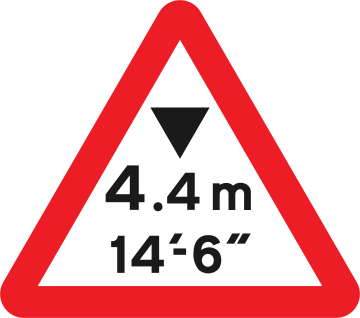
A low bridge sign warns drivers that the headroom under a bridge ahead is limited. According to Know your traffic signs, all bridges with a clearance of less than 16 feet 6 inches (about 5 metres) are normally signed. Driving a vehicle that is too tall under a bridge is dangerous, so you need to know the height of your vehicle, especially if you drive a lorry, bus, coach or motorhome.
If your vehicle is taller than the height on the sign, do not go on. Find a safe place to stop and plan another route.
The warning sign may be put up well before the bridge, with a plate showing the distance in yards or miles. If the bridge is on a side road, the plate may have an arrow. Some low bridges also have signs that show another route, but advance signs are not provided at every low bridge.
The 2 kinds of low bridge sign
Red circle: an order
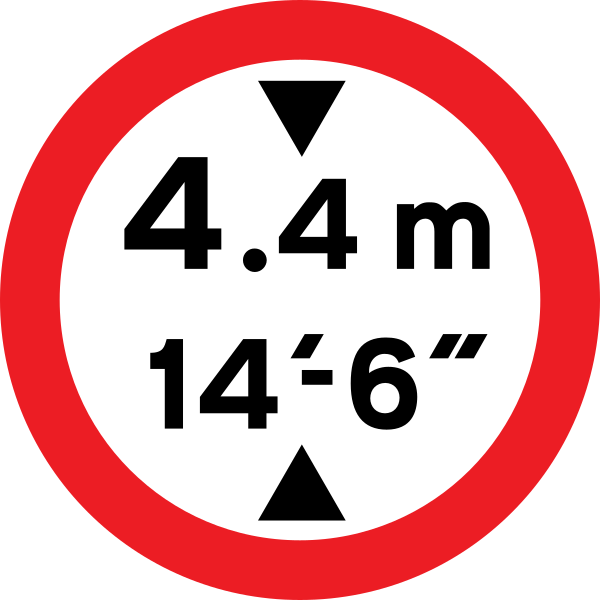
A red circle with a height in it is an order: no vehicle taller than the height shown may pass the sign. It is against the law for a taller vehicle to pass it. These signs are used at bridges that are not arches. They are placed on the bridge itself and at the side of the road before it. The height is shown in metres and in feet and inches, although some older signs still show feet and inches only.
Red triangle: a warning
A red triangle with a height in it warns of the maximum headroom under a bridge or other structure over the road, in metres and in feet and inches. If your vehicle is taller than the height shown, do not pass the sign.
Arch bridges
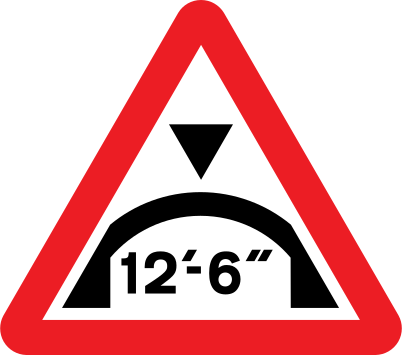
At an arch bridge, the headroom is highest in the middle and lower at the sides. The warning triangle shows the maximum safe headroom, and road markings guide high vehicles through the highest part of the arch. Some arches have markings on the bridge showing where the different heights apply.
All drivers should give way to oncoming high vehicles in the middle of the road when there is not enough room to pass. Drivers of cars and other low vehicles may keep to the left, crossing the road markings, if that lets them pass oncoming vehicles safely.
7 steps, 0:30 Arch bridges: who uses the middle of the arch
Step 1 of 7 Arch bridges: who uses the middle of the arch
Step 2 of 7 Headroom is highest in the middle, lower at the sides.
Step 3 of 7 The sign shows the maximum safe headroom.
Step 4 of 7 At the side, this lorry would hit the arch.
Step 5 of 7 Road markings guide high vehicles through the middle.
Step 6 of 7 Not enough room? Give way to the high vehicle.
Step 7 of 7 Cars may keep left, crossing the markings, to pass safely.
Not loaded Check the connection, then press Try again.
Other signs and markings at low bridges
- Black and yellow bands may be painted on the arches, beams and supports to make a bridge easier to see.
- Where the headroom is low because of an overhanging building or structure, a plate below the warning triangle says so.
- Bridges that are often hit may have a sign with 4 amber lights. A high vehicle passing through an infra-red beam sets the lights flashing, the top pair taking turns with the bottom pair.
- A temporary sign may warn that the headroom under a bridge ahead has been reduced.
Do not confuse it with the hump bridge sign
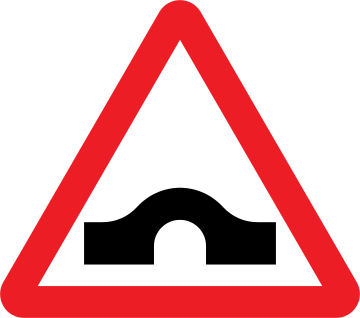
The hump bridge sign is also a warning triangle, but it has no height on it. It shows the road rising over a hump, and warns of a bridge with a steep hump. Slow down, because you may not be able to see what is coming the other way until you reach the top.
Why these signs matter for large vehicles
When a vehicle or its load hits a bridge, it is called a bridge strike. Know your traffic signs says there are hundreds of bridge strikes each year, and that both rail and road users have been killed. Most bridge strikes happen where roads pass under railway bridges.
In 2021 to 2022 there were 1,833 bridge strikes on Britain's rail network, according to Network Rail figures reported by the BBC. The most-hit bridge that year was Stonea Road bridge near Manea in Cambridgeshire. It is 2.1 metres (7 feet) high and was hit 33 times in 12 months.
A bridge strike can damage the vehicle and the bridge, injure or kill people, and stop trains while the bridge is checked. A vehicle stuck under a bridge also blocks the road and causes long delays.
Safe driving near low bridges
Advice for lorry and bus drivers
The government's guides to preventing bridge strikes say professional drivers should:
- know the height and width of their vehicle, including its load and any equipment
- know their route, and obey the traffic signs
- check before each journey that the correct maximum height is shown in the cab
- use a sat nav made for lorries, because one made for cars will not avoid low bridges
- avoid short cuts, which can lead to a low bridge
- stop and get advice on another route if they are diverted, or find a bridge lower than their vehicle on their route
If the height of your vehicle, its load and equipment is over 3 metres, it is an offence not to show the correct maximum height in the cab. The height of a lorry can change, for example when the trailer is loaded, unloaded or changed.
If you are not sure your vehicle will fit, do not try. It is always better to find another way.
Common mistakes and how to avoid them
A common mistake is not knowing the height of your vehicle. Check it before you set off, and check again whenever the load changes. If you are not sure of the height, you might think you have room to pass when you do not.
Another mistake is to think there is some spare room under the height shown on the sign. Do not take that risk. If your vehicle is taller than the height on the sign, do not go under the bridge.
If you have already passed the last place to turn, stop in a safe place, out of the way of other traffic. Turn round only where it is safe. Do not reverse further than you need to (rule 203), check all around before and while you reverse, and get someone to guide you if you cannot see clearly (rule 202). Do not drive with your hazard warning lights on: you may only use them while moving on a motorway or unrestricted dual carriageway, to warn drivers behind of a hazard ahead (rule 116).
If a bridge strike happens
The bridge strike guides say that if you hit a railway bridge:
- Phone the number on the identification plate on the bridge straight away, so that trains can be stopped from crossing it.
- Phone the police on 999. Every bridge strike damages a bridge, so it must be reported.
- Tell your employer.
- Keep the public away and do not move your vehicle.
At any other bridge, report the strike to the police on 999 and then to your employer. Keep the public away and do not move your vehicle.
Preparing for your driving tests
Low bridge signs in the theory test
To get a full driving licence, you need to pass the theory test and then the practical driving test. The theory test is taken on a computer, not on paper. In the multiple-choice part, you may be shown a low bridge sign and asked what it means, or asked to tell it apart from other signs, such as the hump bridge sign or the red circle that sets a maximum height.
Every driver needs to know these signs, even if you only drive a car. A car may be towing a caravan or carrying bikes or a roof box, which makes it taller. And at an arch bridge, you need to know to give way to a high vehicle coming the other way in the middle of the road.
Which vehicles this sign applies to
The sign applies to any vehicle that is taller than the height shown. It is about the height of the vehicle, including its load, not about the type of vehicle. Always know how tall your vehicle is, including anything on the roof.
Vehicles most likely to be affected include:
- lorries, including articulated lorries, box vans and tipper lorries
- buses and coaches, especially double-deck buses
- motorhomes, and vehicles towing tall caravans or trailers
- high-roof vans
- vehicles carrying tall loads, such as machinery on a low-loader or a boat on a trailer
What happens if you ignore a low bridge sign
Ignoring a low bridge sign can lead to:
- the roof of the vehicle being torn off, or the vehicle being badly damaged
- damage to the bridge, which may have to close
- a vehicle stuck under the bridge, blocking the road for hours
- injury or death for the driver, passengers or other road users
- delays to trains and to traffic
Legal consequences of a bridge strike
The bridge strike guides warn that drivers can be prosecuted for offences that can lead to prison or losing their licence, and that a company can lose its operator's licence. The company can also have to pay for examining and repairing the bridge, recovering the vehicle and its load, and delays to trains. Network Rail told the BBC that it tries to recover the full repair and delay costs from the driver and the operator.
Some of the offences a driver could face, with the maximum penalties in the Highway Code (annex 5):
- Careless driving: an unlimited fine, 3 to 9 penalty points, and the court can disqualify you.
- Dangerous driving: up to 2 years in prison, an unlimited fine and a driving ban that the court must order.
- Failing to stop after an accident or failing to report it: up to 6 months in prison, an unlimited fine and 5 to 10 penalty points.
If you get 12 or more penalty points within 3 years, you must be disqualified from driving for at least 6 months. Your insurance is also likely to cost a lot more after a conviction for a serious driving offence.
Why low bridge signs matter
When you see a low bridge sign, there is limited headroom under the bridge ahead, and a tall vehicle may not fit. If you drive a lorry, bus or other tall vehicle, check the height on every sign against the height of your vehicle. If your vehicle is too tall, you could hit the bridge or get stuck under it.
Low bridge signs help prevent bridge strikes. When a bridge is hit, people can be hurt, traffic and trains are delayed, and a badly damaged bridge can be closed for a long time. Read the signs, obey them and plan your route. To keep learning, read our guides to how to get your UK driving licence and the road narrows sign.
Sign pictures: drawings of the official UK traffic signs from Wikimedia Commons. Some are in the public domain. The others contain public sector information licensed under the Open Government Licence v1.0.


